

W&M’s Batten School & VIMS professor makes $1M gift to support graduate students
 For more than two decades, Mary Fabrizio has shaped William & Mary’s Batten School & VIMS through her research, leadership and mentorship of graduate students. Now, as she approaches retirement, Fabrizio is extending that impact well into the future through an extraordinary gift that reflects both her career and her values.
Fabrizio and her husband, Dixon Wilde, have established the Mary C. Fabrizio and Dixon W. Wilde Graduate Fellowship in Fisheries Fund (6097), beginning with an initial $100,000 contribution and an estate commitment currently valued at approximately $900,000. The endowment will provide tuition and fellowship support to graduate students enrolled in the Batten School of Coastal & Marine Sciences & VIMS, with preference given to students from developing nations.
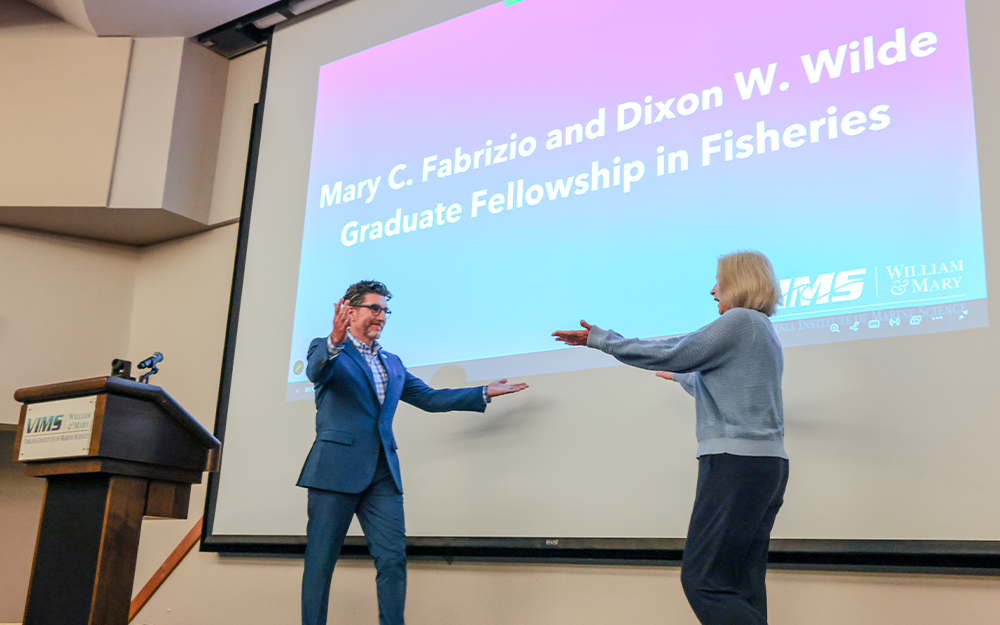
“Graduate students at the Batten School are among the most gifted, dedicated and inspiring students in coastal and marine sciences,” said Fabrizio. “Our gift will provide tuition and a stipend for students to pursue fisheries research and contribute to the Batten School & VIMS’ legacy of impactful research. By focusing on students from developing nations, we not only open the door for greater cross-cultural collaborations, but also affirm that the challenges we face affect the livelihoods, culture and sustenance of people around the world.”
Wilde echoed that sentiment, noting that they felt compelled to foster emerging scientific minds, especially those from places lacking opportunity. “It is our hope that this enduring graduate fellowship will, in a small way, help strengthen those ranks,” he said. “The current threats to the Earth's ecosystems and human population can only be solved by well-trained thinkers with strong visions and voices.”
Global impact, inspired by a student
The emphasis on global reach was shaped by Fabrizio’s experiences with one graduate student in particular. Today, Vaskar Nepal Ph.D. ’20 is an assistant professor of biology at Western Illinois University, but he was once one of Fabrizio’s advisees. Nepal's journey from the South Asian country of Nepal to the Batten School & VIMS opened Fabrizio’s eyes to the academic potential of students from developing nations who often lack opportunities for higher education.
“I wasn't sure how I could help someone from a developing country, but then I learned it's not that different from helping anyone else,” said Fabrizio. “However, through Vaskar’s story, I also learned how difficult it can be to get an education in a different country, come to the U.S. and then try to earn an advanced degree. There are so many brilliant minds around the world, but the opportunities are not all over the world. That needs to change.”
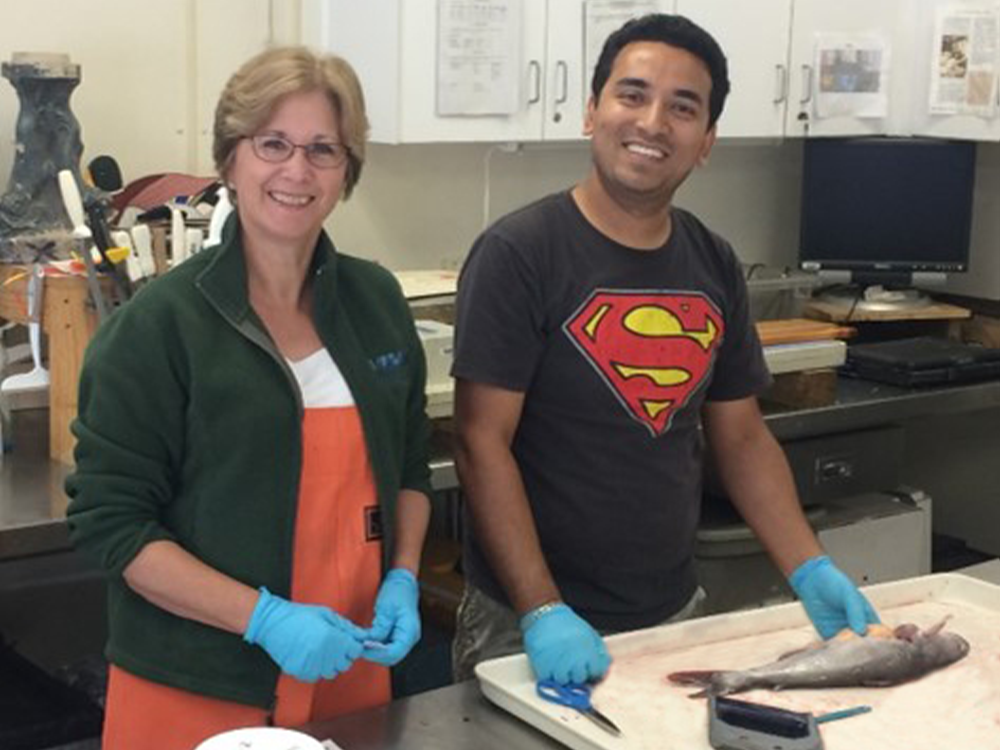
“I knew Mary would give back to the Batten School & VIMS in a big way, but I never imagined my own story would play a role,” said Nepal. “As an international student, I know how much this kind of support matters. I am deeply moved that Mary's generosity will open those same doors for students from developing nations.”
As her office worked with Fabrizio and Wilde to set up the new endowment, Ellen Leverich, executive director of advancement, was similarly touched by a faculty member making such a significant commitment to students following a lifetime of mentorship.
“It's always special when a faculty member is inspired to give back to the Batten School & VIMS,” said Leverich. “Mary has been a prolific researcher, an invaluable mentor to her students and a leader in our community. Now, after decades of consequential work, she is again making a difference in the lives of young scientists by establishing a significant endowment. We couldn't be more grateful for this act of generosity that truly embodies Mary's commitment and passion for our students."
Becoming a fishery science expert and educator
Fabrizio didn’t originally envision herself in the world of fishery studies. “When I was a high school student, I thought fish were slimy and disgusting,” she said with a laugh. “I wanted to be a zooplankton ecologist.”
However, studying fish during a year-long undergraduate research thesis at Fordham University changed her mind. “At the time, it was the closest I could get to marine biology, because the only faculty member who worked on zooplankton was on sabbatical in Russia, but lo and behold, I ended up fascinated by fishery science. I had no idea that fishes were so diverse; it was incredible.”
After wrapping up her undergraduate degree, Fabrizio earned her Ph.D. at the University of Rhode Island before accepting a role with the U.S. Fish and Wildlife Service to study fish populations in the Great Lakes. Her research division was later transferred into the National Biological Survey, and then again absorbed into the U.S. Geological Survey. “I worked for three federal agencies, but stayed at the same desk doing the same job,” joked Fabrizio. “But I was always interested in working with students, and didn’t have formal opportunities when I was a federal scientist.”
Unsurprisingly, Fabrizio jumped at the chance to join the Batten School & VIMS in 2005. Once on the Gloucester Point campus, she dedicated her time to long-running fish recruitment surveys, and to mentoring students.
“It was a little rocky at first,” Fabrizio said, “because the funding for those programs was somewhat uncertain, and we had an old research vessel that was not very workable. When I started, there was a lot of scurrying around to find consistent funding and a new vessel. But once that was solved, we were able to grow the program and use it as a platform for many graduate students to develop thesis and dissertation research projects.”
A career dedicated to serving students
Ultimately, student mentorship became a hallmark of Fabrizio’s career, something Wilde has observed first-hand. “Mary's mentorship of new scientists is one of her strongest attributes,” he said. “As I have witnessed it, her compassion, empathy and patience, coupled with a drive to maintain the highest standards of scientific investigation, are her clear trademarks. She leads by example and her students have almost universally assimilated those attributes.”
Describing his former advisor’s mentorship, Nepal was effusive. “Mary has gone out of her way to support me at every stage of my career, and her example as a scientist and leader is one I continue to follow,” he said. “Above all, she taught me that good science should value rigor and care over flashiness, a lesson that I now try to pass on to my own students.”
 The appreciation is mutual. Despite a career filled with achievements — including serving as president of the American Fisheries Society and receiving notable recognitions such as W&M’s Plumeri Award and the Batten School & VIMS’ Outstanding Teacher Award — Fabrizio insists her greatest accomplishment is her students themselves.
“Watching them go from curiosity to scientific discovery to full-blown professionals — it is so amazing to see that transformation,” she said. “I feel like my job is to open doors and give students opportunities to try things in a safe way.”
Fabrizio also believes that teaching and advising has in turn shaped her as a scientist. “It’s pushed me outside of my boundaries, my comfort zones, because students come up with ideas that I would never have considered,” she said. “By trusting in the process and opening the door, letting the student walk through and have that opportunity, I found myself doing things and learning things that I wouldn't have experienced otherwise.”
It is with that spirit of gratitude for how students have benefitted their lives that Fabrizio and Wilde, who often host students at their home for dinners and discussion, decided to make their gift. Fabrizio hopes other faculty will consider making similar contributions as they are able.
“Think back on your career, on your time here, and on what brought you the most joy,” she urged. “Think about what made your job worth it, what made you want to come into work each morning, and then think about how you can encourage that in future generations.”